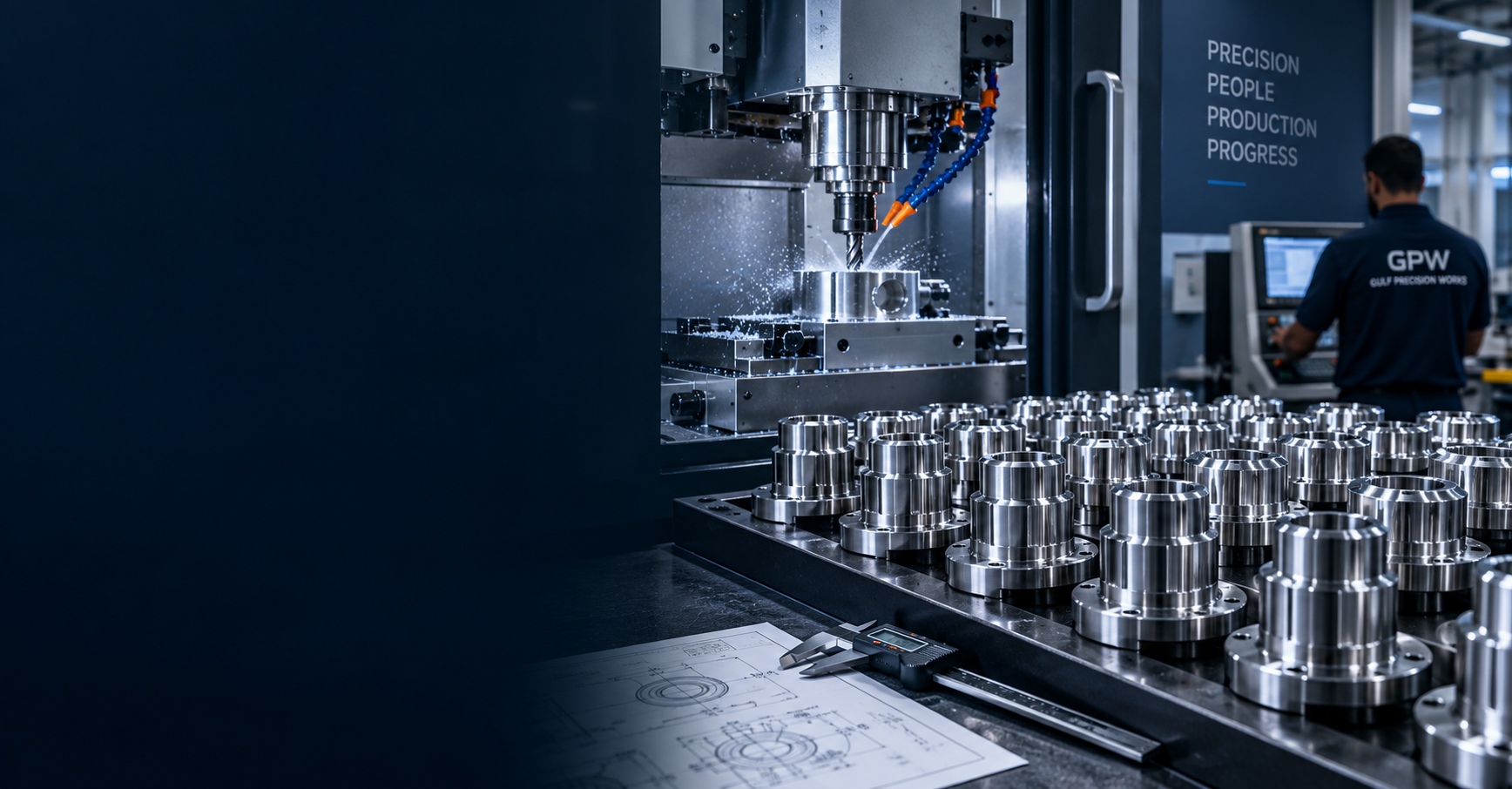
Repeatable CNC Manufacturing
Production Machining Services for Repeat Precision Components.
Consistent Precision Components for Repeat Production and Ongoing Supply.
Gulf Precision Works supports controlled CNC production machining for repeat components, production batches and ongoing supply requirements, with coordinated machining, inspection and project management for customers across the UAE and wider Gulf.
Production Machining Overview
Repeat Production Requires More Than Repeating a Toolpath.
Effective production machining is built around controlled manufacturing conditions, repeatable requirements and consistent quality verification.
As a component moves from prototype or initial batch into recurring production, the manufacturing focus changes. Process definition, revision control, material consistency, critical dimensions and inspection requirements become increasingly important.
Gulf Precision Works supports production machining requirements by coordinating CNC manufacturing, technical requirements, quality documentation and order management for repeat precision components supplied to customers across the UAE and Gulf region.
Process Stability
Production machining benefits from a defined approach to machining sequence, workholding and component requirements.
Repeatable Verification
Critical dimensions and agreed inspection requirements can be checked consistently across production batches.
Revision Control
Production should follow the correct drawing, specification and approved technical revision for each component.
Recurring Requirements
Repeat orders can be coordinated around agreed quantities, project schedules and ongoing component demand.
Production Machining Capabilities
CNC Manufacturing Built for Repeat Production Requirements.
Production machining can combine different CNC processes, component families and inspection requirements within a controlled manufacturing program. GPW supports repeat parts from initial production batches through ongoing supply.
CNC Milling Production
Repeat CNC milling for precision housings, brackets, plates, fixtures and other machined components produced to controlled drawings and agreed production requirements.
CNC Turning Production
Repeat machining of shafts, bushings, sleeves, fittings, threaded components and other rotational parts with drawing-based dimensional requirements.
Mixed Production Components
Projects containing multiple machined part numbers can be reviewed together for coordinated production, inspection and order management.
Repeat Batch Manufacturing
Production batches can follow approved drawings, material specifications and agreed quality requirements for recurring component demand.
Prototype to Production
Components developed during prototyping can progress into repeat manufacturing once drawings, materials and production requirements are defined.
Inspection & Documentation
Agreed inspection requirements and project-specific quality documentation can be coordinated as part of the production scope where required.
Define the Production Requirement Before Scale
Send the drawings, material requirements, quantities, expected repeat demand and inspection requirements for production review.
From First Article to Repeat Production
Move From Initial Verification to Controlled Repeat Manufacturing.
Production machining becomes more reliable when the component, material, drawing revision, inspection criteria and manufacturing requirements are established before recurring batches begin.
Production Review
Drawings, material, quantity, tolerances, finishing and inspection requirements are reviewed before production planning begins.
First Article / Initial Batch
Initial components or a controlled first production batch can establish the agreed manufacturing and quality requirements.
Inspection & Approval
Agreed critical features and dimensional requirements can be verified before the job progresses into recurring production.
Repeat Production
Repeat batches can follow the controlled drawing revision, specified material and agreed production and inspection requirements.
Ongoing Supply
Recurring demand can be coordinated around agreed batch quantities, order requirements and project delivery expectations.
Keep the Key Requirements Controlled
Share the latest drawing revision, material, target batch quantities, inspection requirements and previous production information where available.
From First Article to Repeat Production
Move From Initial Verification to Controlled Repeat Manufacturing.
Production machining becomes more reliable when the component, material, drawing revision, inspection criteria and manufacturing requirements are established before recurring batches begin.
Production Review
Drawings, material, quantity, tolerances, finishing and inspection requirements are reviewed before production planning begins.
First Article / Initial Batch
Initial components or a controlled first production batch can establish the agreed manufacturing and quality requirements.
Inspection & Approval
Agreed critical features and dimensional requirements can be verified before the job progresses into recurring production.
Repeat Production
Repeat batches can follow the controlled drawing revision, specified material and agreed production and inspection requirements.
Ongoing Supply
Recurring demand can be coordinated around agreed batch quantities, order requirements and project delivery expectations.
Keep the Key Requirements Controlled
Share the latest drawing revision, material, target batch quantities, inspection requirements and previous production information where available.
Process Control, Repeatability & Quality
Consistent Production Starts With Controlled Requirements.
Repeat production depends on controlling the technical information that defines the component. Drawings, material specifications, machining requirements, critical dimensions and inspection criteria should remain aligned as components move through recurring production batches.
Establish a Stable Production Baseline
Repeatability becomes easier to manage when the manufacturing requirement is clearly defined before production begins and changes are properly controlled.
Production should follow the current approved drawing and technical revision.
Correct grade, condition and agreed material documentation should be identified as part of the production requirement.
Functional dimensions, datums, threads, fits and other important features should be clearly identified.
Drawing, material or specification changes should be reviewed before the next production batch is released.
Inspection Aligned With Functional Requirements
Quality control should focus on the component characteristics that influence assembly, function, interchangeability and customer requirements.
Agreed component dimensions can be checked against drawing requirements.
Inspection can concentrate on important fits, interfaces, datums and functional features.
CMM verification can support suitable dimensional and geometric inspection requirements.
Project-specific inspection records can be coordinated where required and agreed.
Recurring production can be reviewed against the same controlled component requirements.
Variation affecting functional requirements can be identified and addressed within the agreed production scope.
If you require material certificates, dimensional reports, CMM inspection, first-article documentation or other project-specific quality records, include these requirements with the quotation request.
Consistency Depends on Controlling the Baseline
Include critical dimensions, inspection criteria, material documentation and required quality records with your production RFQ.
Production Planning & Supply Reliability
Plan Repeat Manufacturing Around Real Production Demand.
Reliable production supply depends on more than machining capacity. Batch quantities, part-number requirements, drawing revisions, delivery expectations and repeat-order demand should be coordinated together as part of the manufacturing program.
Batch Planning
Production quantities can be reviewed around practical batch requirements, component demand and the expected frequency of future orders.
Repeat Order Coordination
Recurring production requirements can be coordinated against the current controlled drawing, material specification and agreed scope.
Part Number Control
Multiple production components can be organised around part numbers, drawing revisions, materials and project-specific requirements.
Lead-Time Coordination
Production timing can be reviewed against quantity, material availability, machining scope, inspection needs and project priorities.
Supply Continuity
Ongoing requirements can be coordinated to support repeat supply under agreed production, order and quality requirements.
UAE & Gulf Project Support
GPW supports customer communication, quotation, engineering coordination, order management and supply requirements for UAE and wider Gulf projects.
Better Forecasting Supports Better Production Planning
Share your part numbers, drawings, batch quantities, repeat forecast and target delivery requirements so the production scope can be reviewed together.
Industries We Support
Repeat Production for Demanding Engineering Sectors.
Production machining supports industries where component consistency, controlled drawings, material requirements, inspection criteria and dependable recurring supply are important to the overall project.
Aerospace & Aviation
Production machining support for suitable aerospace and aviation-related components requiring controlled drawings, material requirements and project-specific inspection.
Explore Aerospace & Aviation →Automotive
Repeat manufacturing support for precision automotive components, development parts and production requirements across multiple component types and batch sizes.
Explore Automotive →Oil & Gas
Production support for project-specific fittings, housings, brackets, machined components and other precision parts used within industrial applications.
Explore Oil & Gas →Medical & Precision Equipment
CNC production support for suitable precision equipment components where drawing control, dimensional requirements and project-specific quality verification are important.
Explore Medical & Precision →Industrial Engineering
Repeat machining for machinery components, fixtures, housings, shafts, brackets and other production parts used across industrial and engineering applications.
Explore Industrial Engineering →Defence & Special Projects
Drawing-driven machining support for eligible industrial and special-project components, subject to applicable technical, commercial and regulatory requirements.
Explore Special Projects →Production Controls Should Match the Application
Share your drawings, materials, production quantities, expected repeat demand and quality requirements for technical and commercial review.
Production Machining FAQs
Frequently Asked Questions About CNC Production Machining.
Common questions from engineering and procurement teams sourcing repeat CNC-machined components, production batches and ongoing precision manufacturing support in the UAE and wider Gulf region.
What is CNC production machining?
CNC production machining refers to the repeat manufacturing of machined components using controlled drawings, material specifications, machining requirements and inspection criteria. It can include recurring batches, multiple part numbers and ongoing component supply.
What production quantities can Gulf Precision Works support?
Production requirements can be reviewed from smaller controlled batches through recurring production orders. The appropriate manufacturing approach depends on the component geometry, material, machining content, inspection requirements and expected repeat demand.
Can production machining include both CNC milling and CNC turning?
Yes. Production programs can include CNC-milled components, CNC-turned components and suitable mixed part families where different machining processes are required across the overall project.
Can a prototype component move into repeat production?
Yes. Once the design, drawing revision, material, critical dimensions and quality requirements are established, a component can be reviewed for transition from prototype or development quantities into repeat CNC production machining.
How are repeat production requirements controlled?
Repeat production should be based on the current approved drawing and agreed material, dimensional, finishing and inspection requirements. Any revision or specification change should be reviewed before subsequent production batches are released.
What tolerances can be maintained in production machining?
Achievable tolerances depend on the component geometry, feature size, material, machining process, workholding, production quantity and inspection method. Critical dimensions and geometric requirements should therefore be clearly identified on the technical drawing for review.
Can first-article and inspection documentation be supported?
Project-specific first-article, dimensional inspection, CMM verification, material certification and other quality-documentation requirements can be coordinated where required and agreed as part of the production scope.
What information should I provide for a production machining RFQ?
Provide the latest technical drawings and, where available, 3D models together with material grades, part numbers, production quantities, expected repeat demand, critical tolerances, finishing requirements, target delivery dates and required inspection or quality documentation.
Send your drawings, part numbers, materials, batch quantities and expected recurring demand for production review.
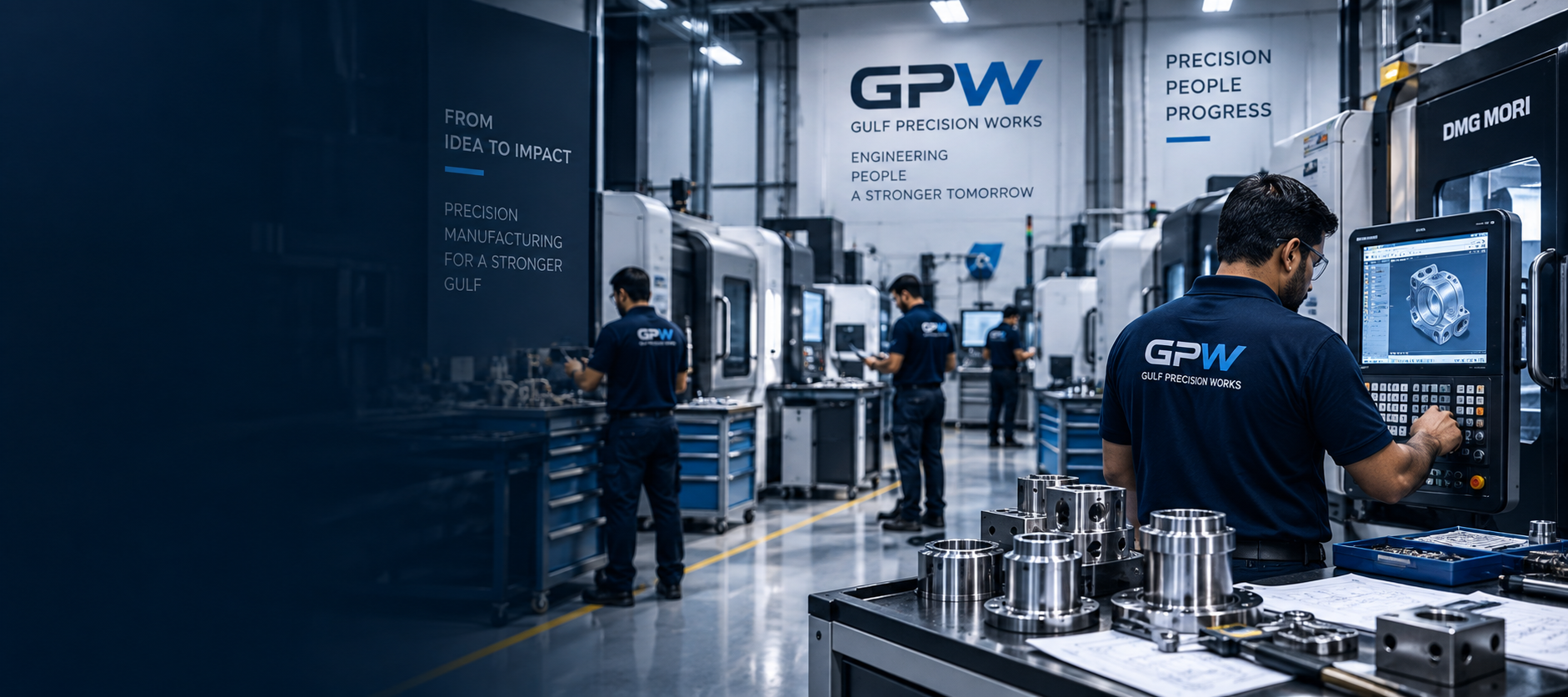
Start Your Production Machining Project
Ready to Move Into Repeat CNC Production?
Share your drawings, part numbers, material specifications, batch quantities, expected repeat demand, quality requirements and target delivery dates with Gulf Precision Works. We can review the complete production scope and coordinate repeat CNC manufacturing for customers across the UAE and wider Gulf region.