Advanced Precision Machining
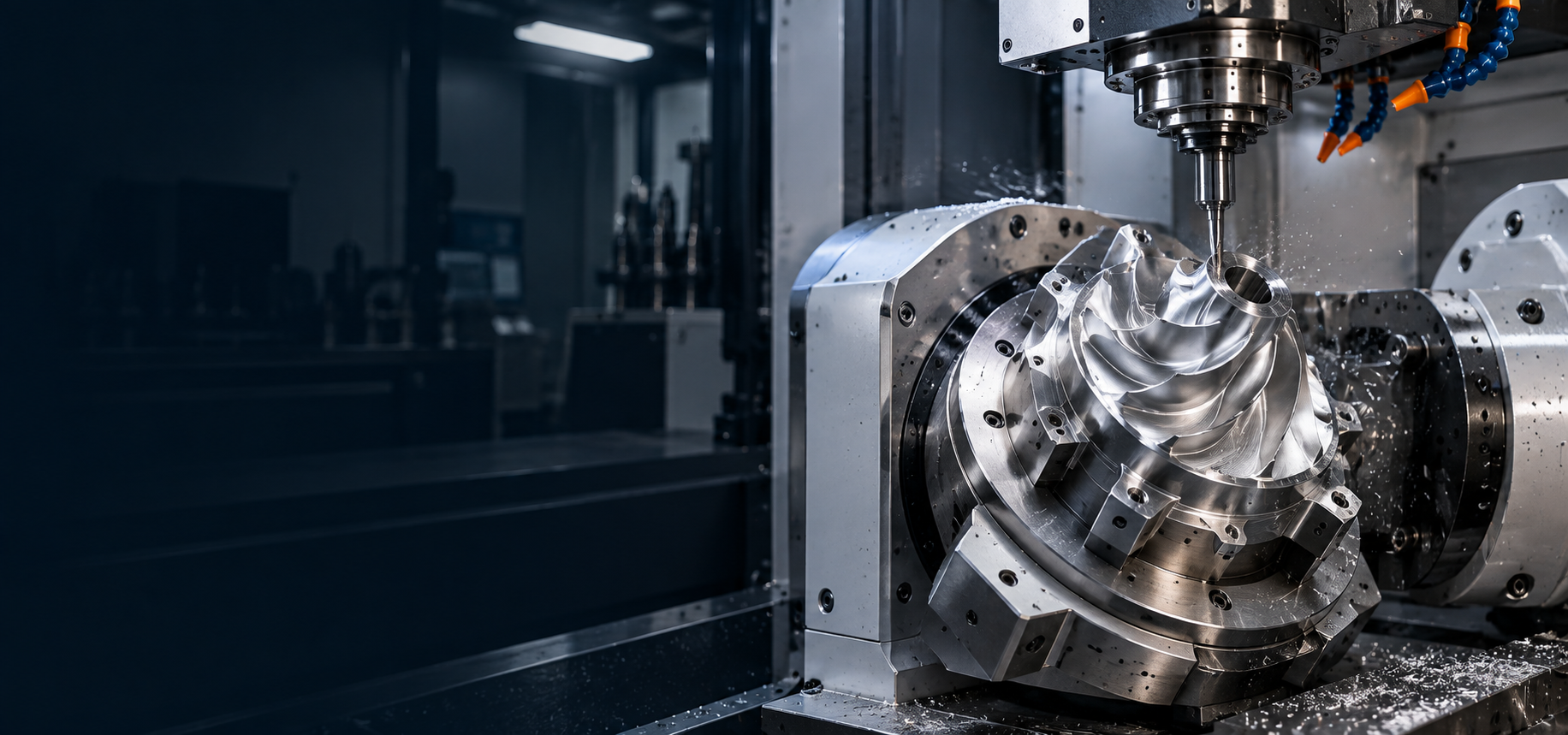
5-Axis CNC Machining
Complex Geometry. Fewer Setups. Precision Manufacturing.
5-axis CNC machining support for complex, multi-surface precision components where geometry, accuracy and manufacturing efficiency demand advanced machining capability — serving customers across the UAE and wider Gulf region.
Advanced Machining Technology
What Is 5-Axis CNC Machining?
5-axis machining enables a cutting tool to approach a component from multiple directions, making it particularly effective for complex geometries and multi-surface precision parts.
Unlike conventional 3-axis machining, where movement primarily occurs along the X, Y and Z linear axes, 5-axis CNC machining introduces additional rotational movement. This allows multiple faces and complex features to be machined with fewer component repositioning operations.
Reducing the number of setups can improve positional consistency between features, provide better access to difficult machining areas and support efficient production of sophisticated precision components.
5-Axis Machining Capabilities
Advanced Capability for Complex Precision Components.
5-axis CNC machining provides greater freedom around the workpiece, supporting complex features, multiple surfaces and demanding geometries that may otherwise require several separate machining setups.
Complex Geometries
Support for intricate component geometry, angled features, curved surfaces and difficult-to-access machining areas.
Simultaneous 5-Axis
Coordinated multi-axis movement supports continuous tool orientation around complex three-dimensional surfaces.
Prototype to Production
5-axis machining can support development components, low-volume requirements and repeat production depending on project scope.
Multi-Surface Machining
Multiple faces can be accessed within fewer setups, helping reduce component repositioning and associated variation.
Complex Contouring
Advanced toolpath capability supports freeform surfaces, sculpted profiles and smooth three-dimensional contours.
Send Gulf Precision Works your drawing, material, quantity and critical dimensional requirements for 5-axis machining review.
Components & Applications
Designed for Parts Where Complexity Matters.
5-axis CNC machining is particularly valuable for components with multiple angled features, complex contours, deep cavities and surfaces that require accurate positional relationships across the part.
Impellers & Turbine-Type Parts
Curved blades, changing surface angles and difficult tool access make impeller-style components well suited to multi-axis machining.
Housings & Enclosures
Precision housings with multiple bores, pockets, angled holes and features across several faces can benefit from fewer setups.
Brackets & Lightweight Frames
Complex brackets, supports and structural components can incorporate pockets, ribs, angled faces and lightweighting features.
Manifolds & Valve Bodies
Multi-face ports, intersecting passages, angled drilling and precision bores can make multi-axis machining advantageous.
Contoured & Sculpted Components
Smooth three-dimensional surfaces and continuously changing profiles benefit from advanced multi-axis toolpaths.
Custom Precision Components
Customer-designed parts with challenging geometry can be reviewed to determine whether 5-axis machining is the appropriate process.
Send us your drawing and technical requirements. We can review the geometry and coordinate the appropriate CNC machining approach for quotation.
Benefits of 5-Axis Machining
More Machining Freedom. Fewer Manufacturing Constraints.
For suitable component geometries, 5-axis CNC machining can reduce the number of setups required, improve access to complex features and support more efficient production of high-precision engineered parts.
Fewer Setups
Accessing multiple component faces within fewer setups can reduce repeated clamping, repositioning and associated handling between machining operations.
Positional Consistency
Machining multiple related features without repeated repositioning can help maintain consistent positional relationships across the component.
Improved Tool Access
Multi-axis positioning allows the cutting tool to approach angled, recessed and otherwise difficult-to-reach features more effectively.
Surface Quality Potential
Appropriate tool orientation and shorter effective tool reach can support better cutting conditions on complex contoured surfaces.
Efficient Complex Machining
Consolidating multiple machining orientations can simplify the manufacturing route for suitable complex components and reduce non-cutting activity.
Reduced Part Handling
Fewer manual setup changes can reduce handling between operations and help streamline the manufacturing process for complex precision parts.
One Setup Can Do More
Send us your drawing for review. The component geometry, material, tolerances and production requirements can be assessed before quotation.
Materials & Tolerances
Material Capability & Precision Requirements.
Material choice, geometry, tolerance requirements and inspection strategy all influence how a 5-axis component should be manufactured. GPW reviews these factors together before coordinating production.
Engineering Materials for 5-Axis Machining
5-axis machining can support a range of engineering materials, subject to component geometry, specification and project requirements.
Material grade, condition and certification requirements should be included with the RFQ where they are critical to the application.
Tolerances Reviewed Around the Component
Rather than applying one generic tolerance claim to every component, dimensional requirements should be assessed against geometry, material, setup, machining process and inspection capability.
Functional and assembly-critical dimensions should be clearly identified on the drawing.
Position, orientation and relationships between features can be reviewed as part of the manufacturing plan.
Surface finish and contoured areas should be specified where function or appearance makes them important.
Dimensional inspection and CMM measurement can support verification of agreed component requirements.
Applying unnecessarily tight tolerances across an entire component can increase manufacturing complexity and cost. Critical requirements should be identified clearly during RFQ review.
Send your technical drawing, material specification and critical dimensions for 5-axis machining review and quotation.
Industries We Support
5-Axis Machining for Demanding Applications.
Advanced 5-axis CNC machining is particularly suited to industries where complex geometry, multi-surface features, dimensional relationships and reliable precision manufacturing are critical.
Aerospace & Aviation
Complex brackets, housings, structural components and multi-surface precision parts for demanding aerospace and aviation applications.
Explore Aerospace →Automotive
Precision prototypes, complex housings, performance components and engineered parts requiring multiple machining orientations.
Explore Automotive →Oil & Gas
Manifolds, valve-related components, precision bodies and engineered parts with angled ports and complex feature relationships.
Explore Oil & Gas →Medical & Precision Equipment
Complex precision components, equipment hardware, fixtures and specialised parts requiring controlled dimensional relationships.
Explore Medical →Electronics
Precision housings, thermal-management components, enclosures and specialised hardware with complex machined features.
Explore Electronics →Industrial Equipment
Complex machine components, tooling, automation hardware and custom engineered parts for industrial applications.
Explore Industrial →The Geometry Determines the Process
Share your drawing, material, quantity and technical requirements for 5-axis machining review and quotation.
Quality & Inspection
Complex Machining Requires Reliable Verification.
Multi-surface 5-axis components can contain critical dimensions and geometric relationships across several faces. Inspection planning helps verify that agreed requirements are achieved before the component progresses to delivery.
Drawing-Based Quality Verification
Inspection requirements should be considered alongside the manufacturing plan, particularly where complex geometry or critical dimensional relationships are involved.
Critical dimensions, tolerances, datums and specified inspection requirements are identified.
Measurement methods are considered according to geometry and agreed project requirements.
Key dimensions and feature relationships are checked against the approved drawing.
Inspection supports component acceptance before finishing, assembly or delivery as applicable.
Verification for Precision Components
Appropriate inspection methods can support verification of complex 5-axis component features and critical drawing requirements.
Verification of specified dimensions against agreed drawing requirements.
Coordinate measurement can support complex geometry and feature verification.
Focus on dimensions and relationships essential to component function or assembly.
Project-specific inspection documentation can be supported where required and agreed.
If CMM reports, dimensional reports, material certificates or other project documentation are required, include those requirements with the quotation request so they can be reviewed before production.
Send the drawing together with your dimensional, CMM and documentation requirements so they can be considered during 5-axis machining review.
Frequently Asked Questions
5-Axis CNC Machining. Common Technical Questions.
Answers to common questions about 5-axis CNC machining, complex components, materials, tolerances, inspection and prototype-to-production manufacturing support.
What is 5-axis CNC machining used for?
What is the difference between 3-axis and 5-axis machining?
Can Gulf Precision Works support simultaneous 5-axis machining?
What materials can be used for 5-axis machining?
Can you support prototypes and production quantities?
What tolerances can be achieved with 5-axis machining?
Can you provide CMM inspection and quality documentation?
Do you provide 5-axis machining services outside the UAE?
Send your drawing and technical requirements to Gulf Precision Works for manufacturing review and quotation.
Start Your 5-Axis Project
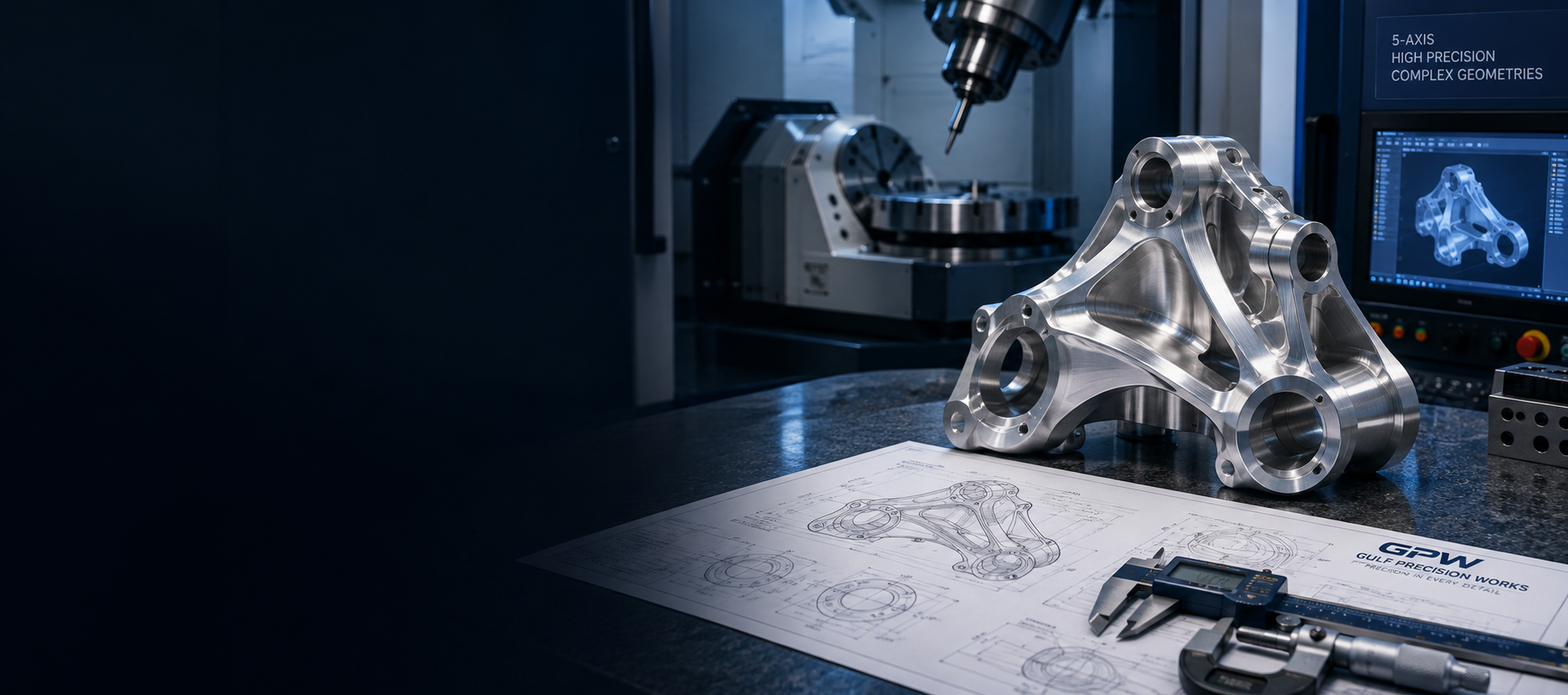
Have a Complex Component? Send Us the Drawing.
Share your component drawing, material, quantity, tolerances and inspection requirements with Gulf Precision Works. We can review the geometry, assess the manufacturing route and coordinate the appropriate 5-axis CNC machining solution for customers across the UAE and wider Gulf.