CNC Machining FAQs & Engineering Answers
Practical answers to common questions about CNC machining, materials, tolerances, quality inspection, prototypes and production requirements for engineering projects in Dubai, across the UAE and the wider GCC.
Find Answers by Topic
Navigate directly to answers covering CNC machining, materials, tolerances, inspection, production and quotation requirements.
Select a topic to explore ↓Looking for deeper engineering guidance beyond a quick answer? Explore our CNC machining resources, materials information and manufacturing guides.
Engineering Resources →01 What CNC machining services does Gulf Precision Works support?
Gulf Precision Works supports precision CNC machining requirements including CNC milling, CNC turning, 5-axis machining, prototype manufacturing and production machining for engineered metal and plastic components.
The appropriate manufacturing process depends on component geometry, material, tolerance requirements, quantity and inspection requirements.
02 What is the difference between CNC milling and CNC turning?
CNC milling generally removes material using rotating cutting tools while the workpiece is held in position. It is commonly used for housings, plates, brackets, pockets, profiles and components with multiple machined faces.
CNC turning rotates the workpiece while a cutting tool removes material. It is typically suited to cylindrical components such as shafts, bushes, pins, sleeves and precision fittings.
03 When should a component be manufactured using 5-axis CNC machining?
5-axis machining is particularly useful for components with complex geometries, multiple angled surfaces, deep features or areas that would otherwise require several separate machining setups.
Machining multiple surfaces in fewer setups can also help reduce repositioning and support dimensional relationships between critical features. The actual process should be selected after reviewing the component geometry and tolerance requirements.
04 Can you machine complex precision components?
Complex CNC components can be reviewed for features such as multiple machined faces, pockets, bores, threads, compound angles, contours and closely controlled dimensional relationships.
Manufacturability depends on factors including tool access, material, feature depth, wall thickness, tolerance and inspection access. Reviewing the 3D model and engineering drawing before production helps determine an appropriate machining strategy.
05 Can Gulf Precision Works support both prototypes and production quantities?
Yes. CNC machining can support prototype components, engineering development quantities, low-volume requirements and repeat production depending on the component and project.
For repeat manufacturing, drawing revision, material, inspection requirements and other agreed specifications should remain controlled so subsequent batches can be reviewed against the correct project requirements.
06 What information is needed to determine the best CNC machining process?
A technical review normally considers the 2D drawing, 3D CAD model where available, material, quantity, dimensional tolerances, GD&T, surface finish, post-machining treatment and required quality documentation.
These details help determine whether the component is better suited to milling, turning, 5-axis machining or a combination of manufacturing operations.
07 Do you review drawings for manufacturability before machining?
Technical review can identify manufacturing considerations such as tool access, deep pockets, thin walls, internal corners, difficult tolerance combinations and features that may require additional setups or specialised inspection.
Where appropriate, manufacturability observations can be discussed before production while maintaining the engineering intent of the component.
08 Do you support CNC machining enquiries from Dubai and across the UAE?
Gulf Precision Works supports CNC machining enquiries from engineering and procurement customers in Dubai, across the UAE and the wider GCC.
Customers can submit drawings, CAD files and project requirements for technical review and quotation.
Materials & Tolerances
Material properties, component geometry and tolerance requirements are closely connected. Selecting the appropriate combination helps balance manufacturability, performance, inspection and cost.
01 What materials can be CNC machined?
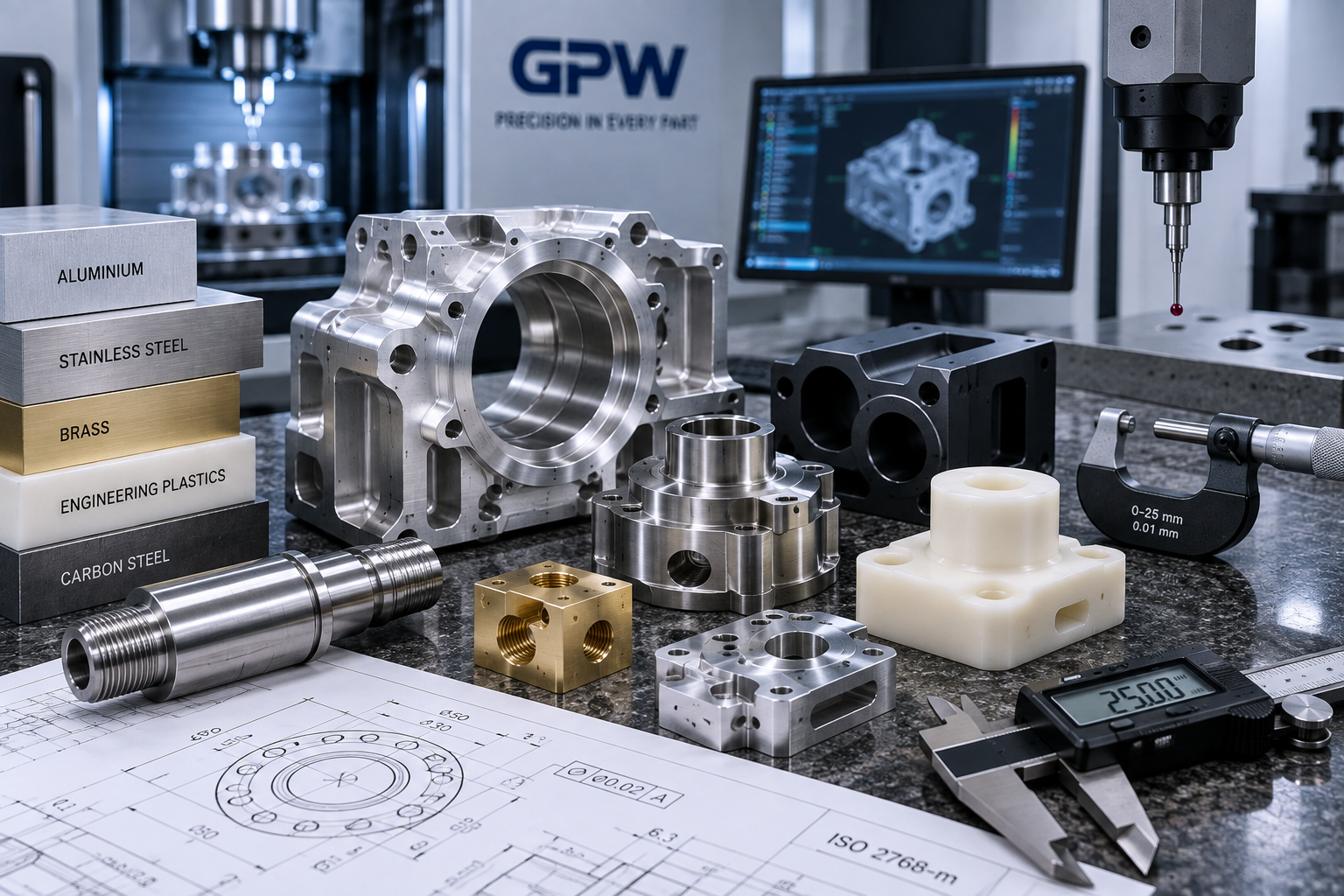
CNC machining can be applied to a broad range of engineering metals and plastics. Typical project materials can include aluminium alloys, stainless steels, carbon and alloy steels, copper alloys and suitable engineering plastics.
Material availability and suitability should be confirmed against the specific drawing, grade, component function and project requirements.
Explore CNC Materials →02 How should I choose a material for a CNC machined component?
Material selection should consider the component's mechanical, thermal, corrosion, weight, wear and operating requirements, as well as machining characteristics and any required post-machining treatment.
Where the material is already defined by the engineering drawing or customer specification, the specified grade should be included with the RFQ.
03 What tolerances can CNC machining achieve?
Achievable machining tolerance is not a single value for every component. It depends on factors including material, feature size, geometry, machine setup, tool access, thermal behaviour and the method used to inspect the feature.
Critical tolerances should therefore be identified on the engineering drawing and reviewed before quotation and production.
04 Should every dimension have a very tight tolerance?
Not necessarily. Tight tolerances are most useful where a dimension directly affects fit, function, alignment, assembly or another critical engineering requirement.
Applying unnecessarily restrictive tolerances to non-critical features can increase machining and inspection complexity. Functional requirements should determine where tighter control is needed.
05 Can you machine components with GD&T requirements?
Engineering drawings containing GD&T can be reviewed as part of the technical assessment. Datum structures, positional requirements, profile controls and other geometric requirements can influence machining setup and inspection planning.
The complete drawing should be supplied so individual controls can be interpreted in the context of the component and its functional requirements.
06 Can material certificates or traceability be requested?
Where material certification, identification or traceability is required, it should be stated during the RFQ stage so the requirement can be reviewed together with the material specification and manufacturing documentation.
Quality Assurance →Prototype, Production & Finishing
Understand how CNC machining can support prototype development, repeat production and post-machining finishing while maintaining the drawing, material and quality requirements defined for the project.
01 Can you manufacture one-off or prototype CNC parts?
CNC machining can be suitable for one-off components, engineering prototypes and development quantities where the required geometry, material and tolerances are compatible with the machining process.
Providing the latest drawing and 3D CAD model helps the component and its manufacturing requirements to be reviewed before quotation.
02 Can a prototype move into repeat production?
Yes. Where a prototype is approved for further production, the subsequent requirement can be reviewed using the controlled drawing revision, material specification, tolerances and agreed quality requirements.
Any design changes made after prototype evaluation should be incorporated into the latest approved engineering data before repeat manufacturing.
03 What production quantities can CNC machining support?
CNC machining can support different production volumes, from prototype and low-volume requirements through repeat production, depending on component geometry, material, machining time, setup requirements and project economics.
Providing the expected order quantity and, where relevant, anticipated repeat demand allows the manufacturing approach to be reviewed more effectively.
04 What surface finishes can be specified for CNC machined parts?
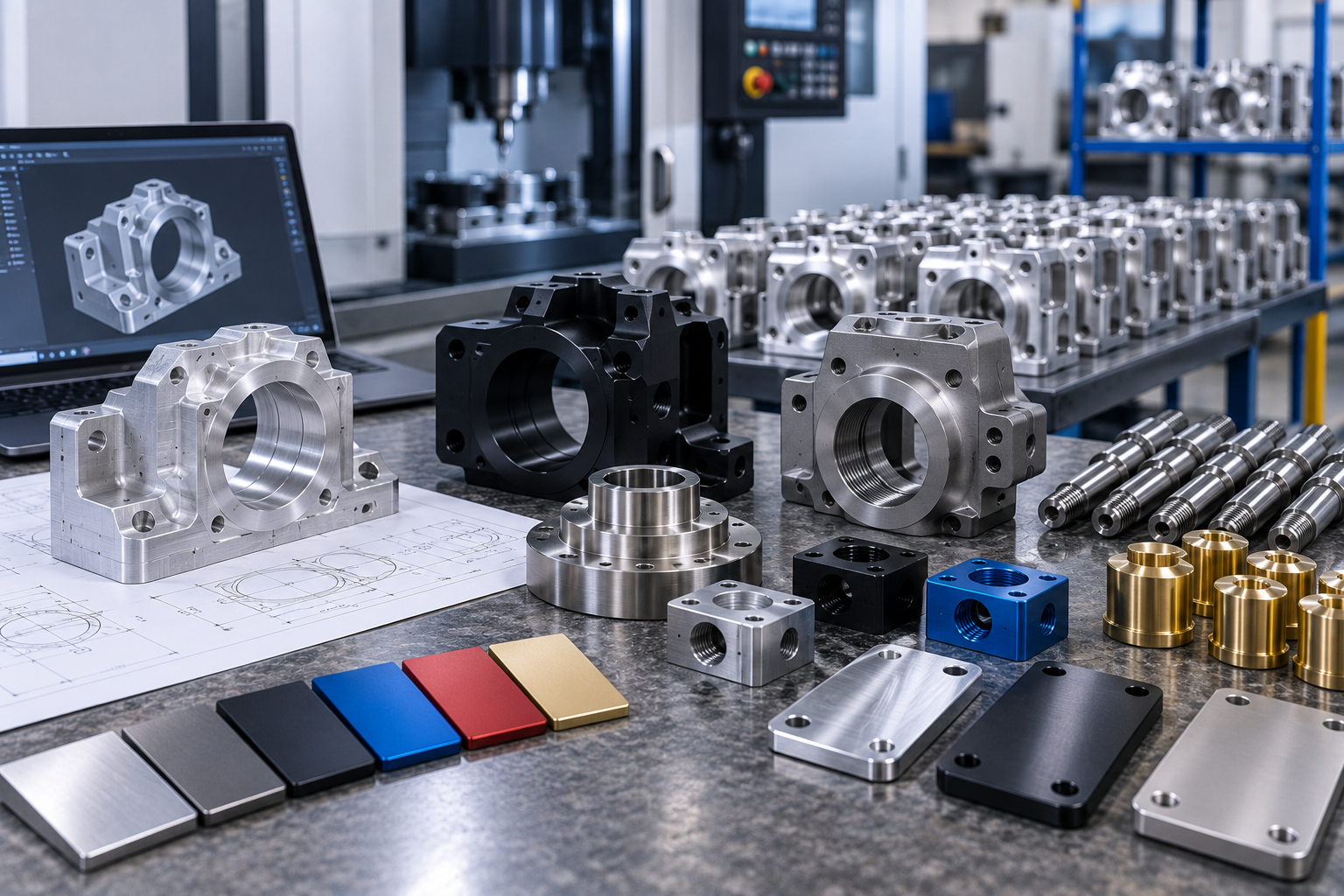
Depending on material and application, CNC components may require an as-machined finish or additional post-machining processes such as anodising, plating, coating, polishing or other specified surface treatments.
The required finish, colour where applicable, specification and any critical masked or controlled surfaces should be identified with the RFQ.
05 Can aluminium CNC parts be anodised?
Suitable aluminium components can be specified with anodising requirements where appropriate to the alloy and application. The anodising specification should be defined as part of the project requirements.
Designers should also consider that post-machining treatment can affect surfaces and dimensions, particularly where tightly controlled fits or critical features are involved.
06 Should surface finish requirements be included on the engineering drawing?
Yes. Functional surface-finish requirements, roughness values, coating specifications and other post-machining treatments should be clearly identified in the drawing, specification or RFQ documentation.
This helps ensure machining and finishing requirements are considered together during technical review.
RFQ, Lead Time & UAE Supply
Clear engineering information helps us review your component, manufacturing requirements and quality expectations efficiently before preparing a CNC machining quotation.
Submit an RFQ →Latest 2D drawing and 3D model where available.
Material type, grade and certification requirements.
Required quantity and anticipated repeat demand.
Critical dimensions, GD&T and functional features.
Surface finish, coating and post-machining treatment.
Inspection, traceability and documentation requirements.
01 What information should I provide for a CNC machining quote?
For an effective technical review, provide the latest engineering drawing, 3D CAD model where available, material specification, required quantity, tolerances, surface treatment and any mandatory inspection or documentation requirements.
Project-specific requirements should be identified before quotation so they can be considered as part of the proposed manufacturing approach.
02 Should I provide both a 2D drawing and a 3D CAD model?
Where available, providing both is useful. The 3D model communicates component geometry, while the controlled 2D drawing can define tolerances, GD&T, surface finish, material and other manufacturing or inspection requirements.
The drawing revision and CAD data should correspond to the same intended component configuration.
03 What affects CNC machining lead time?
Lead time can be influenced by component complexity, quantity, material availability, machining time, tooling and setup requirements, inspection scope, post-machining treatment and required documentation.
For this reason, project timing is best confirmed after the complete technical requirement has been reviewed rather than applying one standard lead time to every CNC component.
04 Is there a minimum order quantity for CNC machining?
CNC projects can range from prototype and development quantities to repeat production. Commercial suitability depends on the individual component, material, setup, machining operations and total project requirements.
Submit the required quantity with the RFQ so the project can be reviewed on its actual manufacturing requirements.
05 Can I request a quotation for several different CNC components?
Yes. Multiple component requirements can be submitted for review. Each part should be clearly identified with its drawing or part number, revision, material, quantity and applicable technical requirements.
Organised RFQ information is particularly useful where a project contains several different machined components.
06 Do you support CNC machining enquiries from Dubai and across the UAE?
Yes. Gulf Precision Works supports engineering and procurement enquiries from customers in Dubai and across the UAE for precision CNC machined components.
Drawings and project requirements can be submitted for technical review and quotation.
07 Can Gulf Precision Works support enquiries from other GCC markets?
Gulf Precision Works can review precision machining enquiries from customers across the wider GCC. Project requirements, quantity, documentation and delivery expectations should be included with the enquiry for review.
Send them for technical review and CNC machining quotation.
Still Have a Technical Question?
Every CNC machining project is different. Send us your drawing, material, quantity, tolerances and quality requirements for technical review and quotation.